Section 01
Before abstraction took over and galleries moved uptown, a loose tribe of foreign artists made the Left Bank the studio capital of the world.
Section 02The Quarter That Assembled Itself
Nobody planned the School of Paris. There was no manifesto, no founding committee, no shared style — only a convergence of the displaced, the ambitious and the brilliantly strange, all of them drawn south across the Seine to where the rents were cheap and the cafés stayed open late. In the decade on either side of the First World War, and with furious intensity through the 1920s, Montparnasse became the address that mattered: not just for French painters, but for the artists the world had exported to Paris and then half-forgotten to export back.
They came from everywhere. Amedeo Modigliani from Livorno, with his elongated figures and his catastrophic beauty. Chaïm Soutine from a shtetl in what is now Belarus, painting carcasses and bellhops with equal, anguished intensity. Marc Chagall from Vitebsk, filling his canvases with floating lovers and improbable animals. Jules Pascin from Bulgaria. Moise Kisling from Kraków. Constantin Brâncuși from Romania, who arrived on foot — according to legend, walking much of the way — and stayed to reinvent sculpture from its foundations up. The French term École de Paris was coined to acknowledge what everyone could already see: that the art world had physically relocated to a small grid of streets on the Rive Gauche.
Amedeo Modigliani from Livorno, with his elongated figures and his catastrophic beauty.
Section 03Studios, Cafés, and the Currency of the Quarter
The infrastructure of this world was modest. Artists rented studios in the cités d'artistes — the La Ruche complex in the nearby 15th arrondissement was a particular hive, its wedge-shaped ateliers housing Chagall, Soutine and Léger among many others. By day the work happened in the studios; by night it migrated to the terraces and banquettes of the grand brasseries on the boulevard du Montparnasse. La Rotonde was where arguments were settled and debts deferred. Le Dôme was where the German painters gathered before the war changed everything. La Coupole, when it opened in 1927, was large enough to contain the whole scene at once and noisy enough to drown out its contradictions.
Modigliani is the period's most burnished myth — the handsome, tubercular maudit who sold almost nothing in his lifetime and is now among the most coveted painters of the twentieth century. His nudes, shown at the Berthe Weill gallery in 1917, were shuttered by police within hours for indecency. He died in 1920, aged thirty-five, the cold and the poverty and the drinking compounded by tubercular meningitis. His partner Jeanne Hébuterne died the following day. The story has been romanticised beyond rescue, but the paintings need no mythology: their long necks and asymmetric eyes, their frank sensuality, are among the most immediately recognisable images the quarter produced.
- Pre-1914foreign artists begin converging on Montparnasse; La Ruche studios active
- 1910s–1920speak of the École de Paris; Modigliani, Soutine, Chagall, Brâncuși all active in the quarter
- 1920Modigliani dies; his posthumous reputation begins its rapid rise
- 1927La Coupole opens; the scene reaches its most public, social phase
- 1930spolitical pressures, Depression and approaching war begin dispersing the community
Section 04What Remains
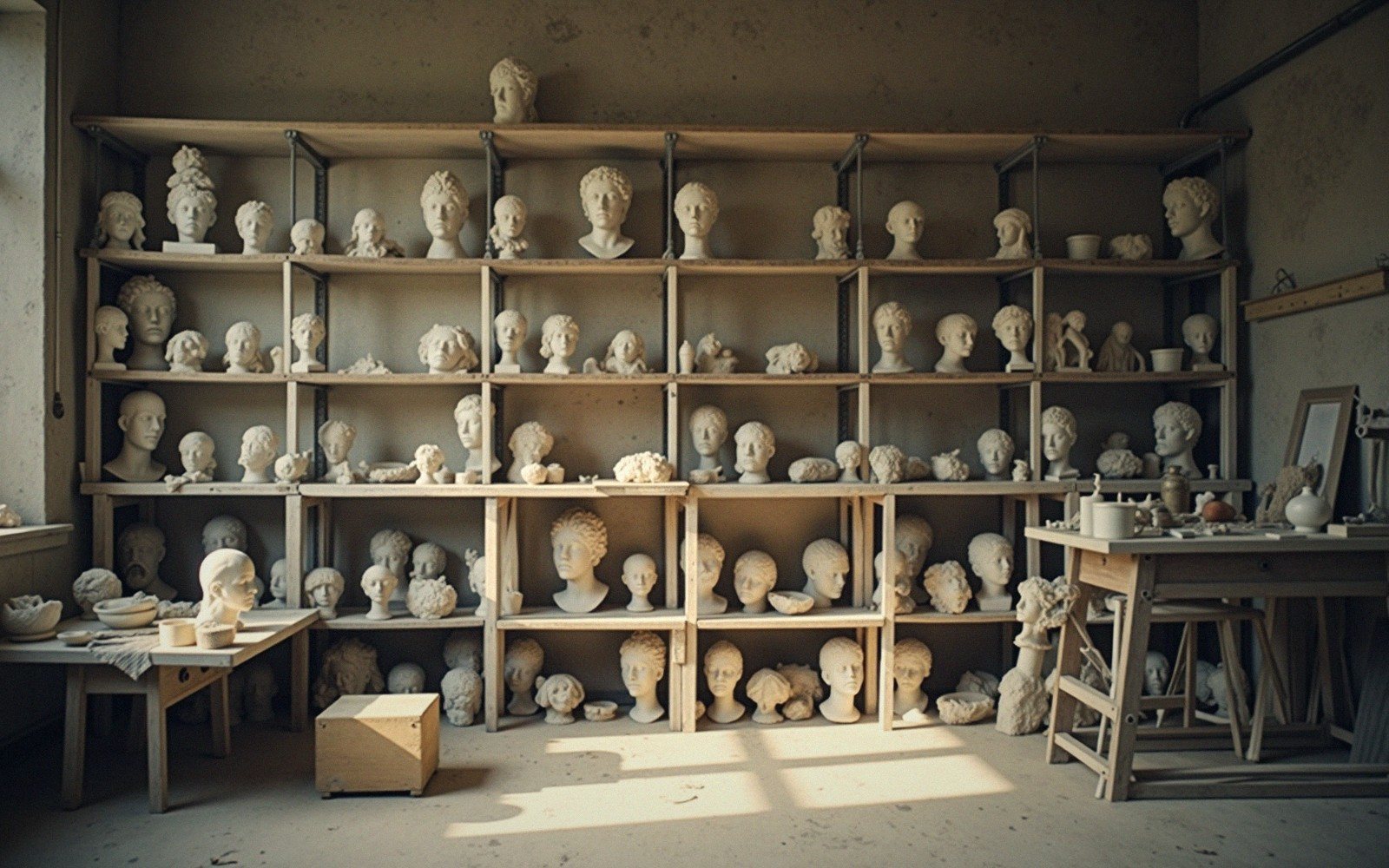
Brâncuși's legacy survives in concentrated form. His reconstructed studio — originally in the impasse Ronsin — is now preserved adjacent to the Centre Pompidou across the river, its white forms and rough-hewn bases arranged as he left them. Antoine Bourdelle, a different order of sculptor entirely — monumental, deeply rooted in the Western tradition — worked and lived a few streets from the boulevard; the Musée Bourdelle preserves his studio and garden essentially intact, plaster studies crowding every surface. The smaller, stranger Zadkine studio-museum, hidden off the rue d'Assas, offers the Cubist sculptor's house and garden in the same spirit of kept time.
The School of Paris scattered with the 1930s and the gathering catastrophe of the Second World War. What it left behind was a quarter permanently marked by the ambition of its arrivals — and a few rooms, still open, where the sculpture sits in the same light it always did.
Who & wherePeople & Places
Amedeo Modigliani (person)
Italian painter and sculptor, central figure of the École de Paris
Chaïm Soutine (person)
Belarusian-born Expressionist painter, known for visceral, distorted subjects
Constantin Brâncuși (person)
Romanian sculptor who radically simplified form; studio reconstructed near Pompidou
Marc Chagall (person)
Russian-born painter of dreamlike figurative work; resident at La Ruche
Antoine Bourdelle (person)
French sculptor, pupil of Rodin; studio preserved as Musée Bourdelle
Ossip Zadkine (person)
Cubist sculptor; studio-museum preserved off rue d'Assas