Section 01
Three rooms that fed a century of argument — and still pour until midnight
Section 02The Tables That Defined a Quarter
There is a stretch of the boulevard du Montparnasse, centred on the Carrefour Vavin, where four brasseries face each other across the pavement at intervals so close you could almost read another diner's newspaper from the opposite terrace. That proximity was never accidental. These establishments were, for a generation of artists and writers in the early twentieth century, the practical infrastructure of bohemian life — the place to cash a cheque on credit, receive a letter, or simply sit for four hours over a single coffee without reproach. The neighbourhood still turns on these tables, and the rooms behind them are among the most atmospheric in Paris.
La Coupole, Le Dôme, La Rotonde: each has its own character, its own physical beauty, and its own complicated relationship with the legend it is partly obliged to perform. Visiting all three on a single evening — an aperitif in one, dinner in another, a late glass in the third — is one of the Left Bank's most satisfying rituals, and one that rewards knowing a little about what you're walking into.
The neighbourhood still turns on these tables, and the rooms behind them are among the most atmospheric in Paris.
Section 03Three Rooms, Three Registers
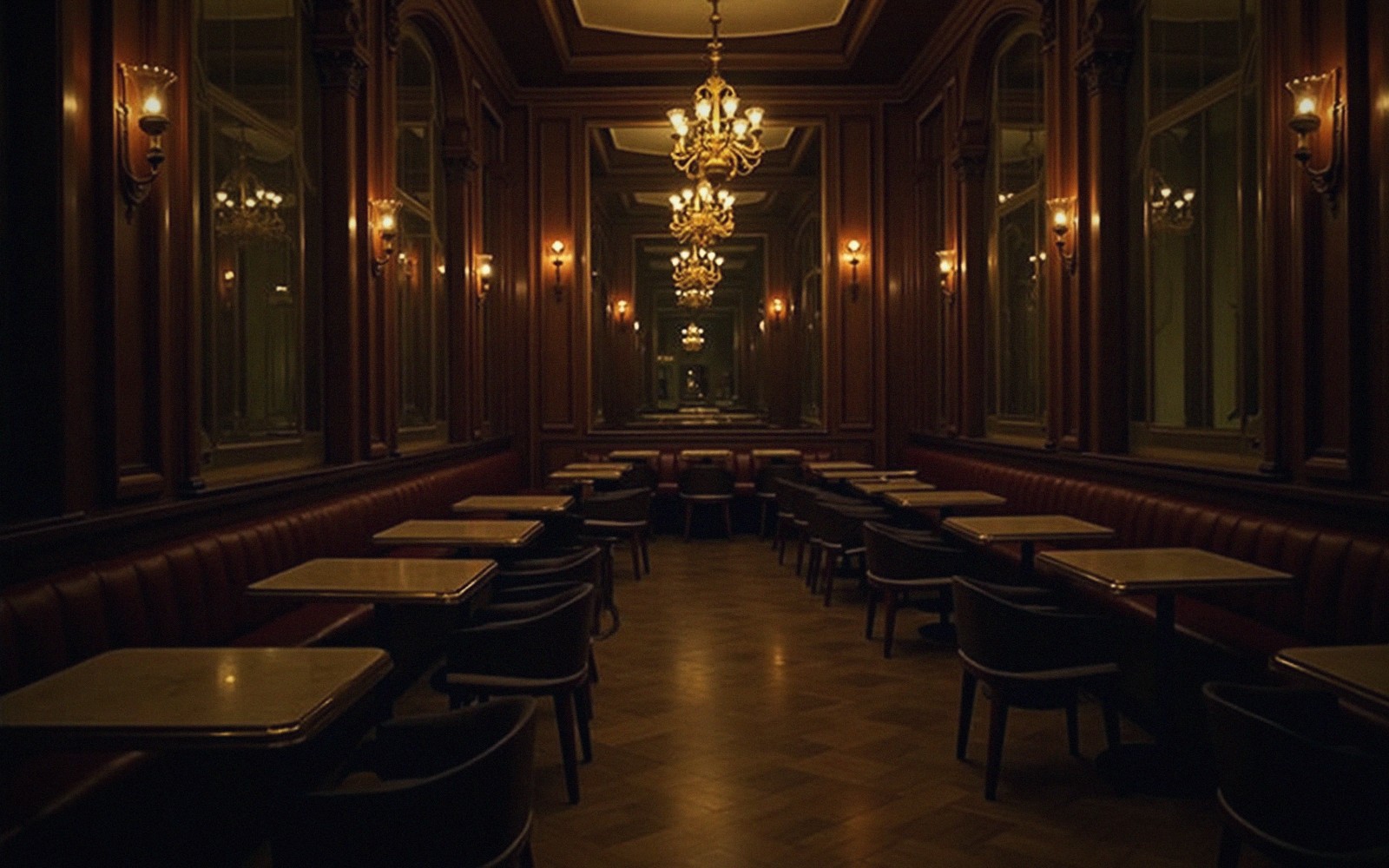
La Coupole is the grandest and the most theatrical. It opened in 1927 and immediately became the largest brasserie in Paris, a reputation it has barely surrendered. The dining room is a monument to Art Deco confidence: a vast coffered ceiling supported by painted columns, each one originally decorated by a different artist from the quarter's circle. The scale is genuinely impressive in person — photographs rarely convey how large the room is, or how well the amber light holds it together at night. The menu runs to classic brasserie fare, with the seafood plateau a perennial centrepiece. It stays open late, which in Paris means it fills twice: once for dinner, then again after the theatres close.
Le Dôme occupies the opposite register. It opened earlier — in the first years of the twentieth century — as a modest café before its transformation into the brasserie it is today, and it carries itself with the assurance of an institution that has nothing to prove. The room is smaller, darker, more serious. Its reputation is built on fish and shellfish, and the kitchen has never seen much reason to deviate. Hemingway mentions it; Modigliani knew the terrace; the names accumulate without the place having ever needed to trade on them conspicuously. An evening at Le Dôme rewards those who prefer a meal to an event.
La Rotonde sits at the apex of the Carrefour Vavin and has the most storied corner in Montparnasse. It was already famous before the First World War — a gathering point for the painters and sculptors who lived in the studios nearby, among them figures who would go on to define what became known as the School of Paris. Constantin Brâncuși was a regular; so was nearly everyone else whose name appears on the plaques and monuments scattered through the quarter. The current room is a handsome renovation that retains the original sense of the corner site, with sightlines through both sets of windows onto the boulevard's constant theatre. The brasserie menu is solid and unfussy — the point, here, is as much the location as the kitchen.
- Early 1900sLe Dôme opens as a modest café
- Pre-1914La Rotonde established as an artists' gathering point
- 1927La Coupole opens as the largest brasserie in Paris
Section 04How to Approach Them
None of these places requires an occasion, though they are very good for one. A solo dinner at the zinc bar of Le Dôme, or a late-night coffee at La Coupole after a walk along the boulevard, does as well as a full table for eight. The terraces are heated in cooler months and worth using — sitting outside at the Carrefour Vavin, watching the corner turn over, is one of those experiences that the word flâner was made to describe.
Prices are honest for what is offered: these are not tourist traps charging for a name, but working brasseries that happen to carry a century of history in the woodwork. The service is professional in the French sense, which means it will not rush you and does not expect to be rushed. Come in the early part of the evening to choose your table; come late if you want the room at its most alive, when the noise lifts and the mirrors earn their keep.
The writers who once made this boulevard their address are long gone, of course. But the rooms hold their shape, the light is the same amber it always was, and the food — properly ordered, properly eaten — makes an argument for staying.
Who & wherePeople & Places
La Coupole
landmark Art Deco brasserie, boulevard du Montparnasse, opened 1927
Le Dôme
historic brasserie known for fish and shellfish, Carrefour Vavin
La Rotonde
corner brasserie at Carrefour Vavin, meeting point of the School of Paris
Carrefour Vavin
crossroads at the heart of Montparnasse, where the grands cafés cluster
Constantin Brâncuși
Romanian-French sculptor, regular at La Rotonde
Ernest Hemingway
American writer, associated with Le Dôme and the quarter's café life