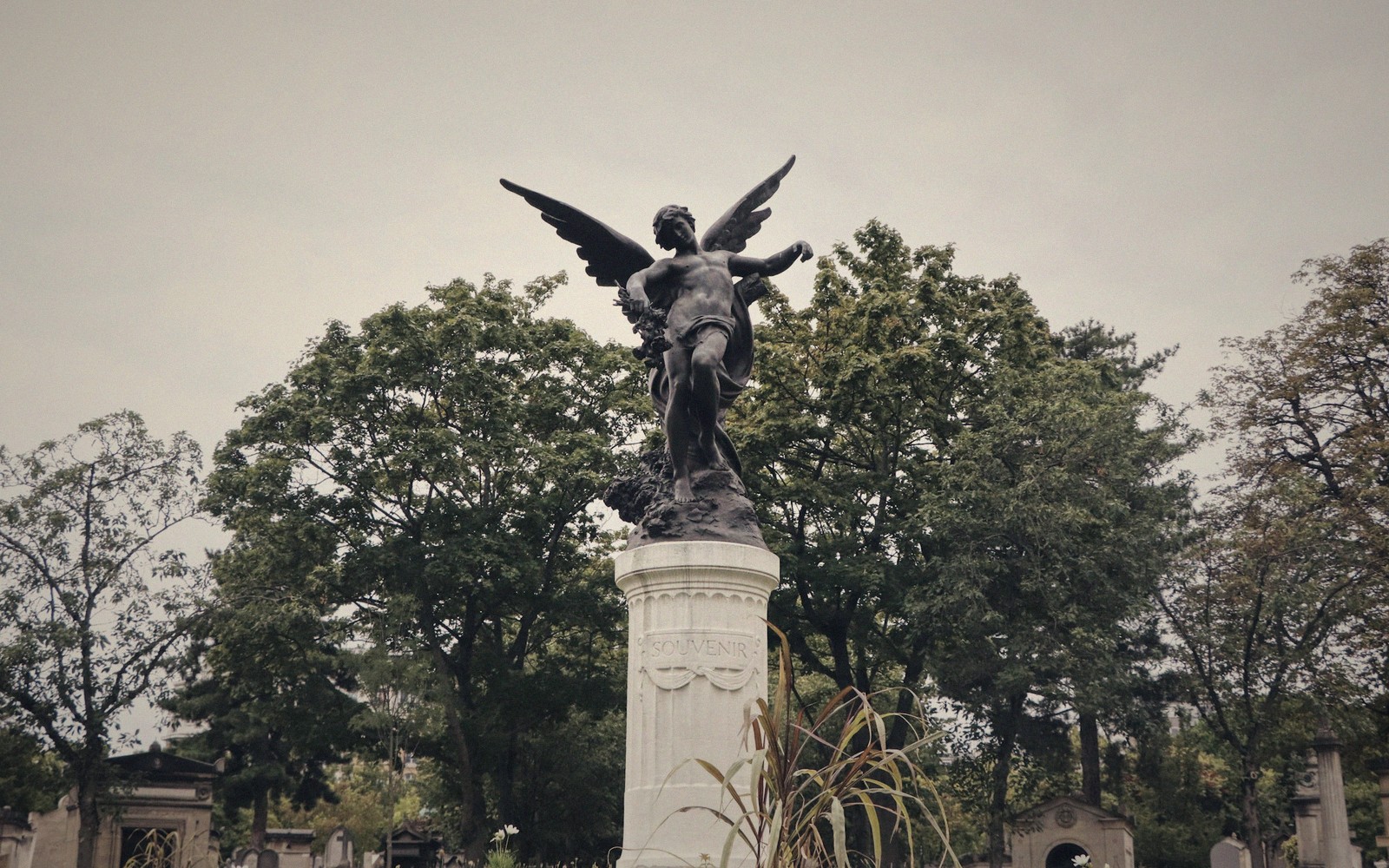
Section 01Stone and silence in the afternoon light
Paris keeps its dead well. The Cimetière du Montparnasse — occupying a broad, walled rectangle just south of the boulevard — is not Père-Lachaise: it draws fewer tourists, produces less theatre, and rewards the visitor who simply walks. Come in the low light of a late afternoon, when the shadows fall long between the tombs and the stone takes on the colour of old bone.
The cemetery opened in the early nineteenth century on the site of three merged farms, and its grid of avenues has a quiet municipal logic to it — none of the gothic romanticism of the hill cemeteries on the Right Bank. What it offers instead is intimacy. The tombs crowd close; the cats move through the ivy; the traffic on the boulevard Edgar-Quinet seems very far away.
Section 02Who lies here, and where to find them
Begin, if you like, with the philosophers. Jean-Paul Sartre and Simone de Beauvoir share a grave near the main entrance on the boulevard Edgar-Quinet — a plain slab, usually dressed with metro tickets, pebbles, and handwritten notes left by readers. It is one of the most visited graves in Paris, and one of the least showy: two people who reshaped how the twentieth century thought about freedom and existence, marked by a flat stone that tells you almost nothing. The restraint feels right.
Charles Baudelaire is buried here too, though his monument requires a little navigation. He lies in the family tomb of his stepfather, General Aupick — an arrangement that would have displeased him — near a cenotaph erected separately in his honour. The cenotaph is the more compelling stop: a shrouded effigy that manages to be both lugubrious and theatrical, entirely in keeping with the poet who made beauty out of rot and melancholy out of Paris streets.
The sculptor Constantin Brâncuși, who lived and worked for decades in a studio in the impasse Ronsin, near Montparnasse station, is buried here with a marker of his own design. His Le Baiser — "The Kiss" — stands in the cemetery as a funerary monument for another occupant, and it is worth finding: a limestone block in which two figures merge in an embrace so simplified it verges on the geometric, yet is unmistakably tender. Brâncuși carved it in 1910 for the grave of a young Russian woman, Tatiana Rachewskaia. It stands, small and absolute, in Division 22 — possibly the finest work of sculpture you will encounter in the open air on the Rive Gauche.
There are others, gathered by the luck of geography and the habits of a quarter that long attracted writers, painters, and thinkers. The writer Guy de Maupassant has a tomb here; so does the engineer Frédéric-Auguste Bartholdi, who designed the Statue of Liberty; and the photographer Man Ray, who spent much of his life between New York and Montparnasse and asked to be buried here with an inscription reading unconcerned but not indifferent.
Charles Baudelaire is buried here too, though his monument requires a little navigation.
Section 03How to walk it
The cemetery covers around nineteen hectares, divided into numbered divisions by well-signed avenues and smaller paths. A free map is available at the entrance gates; the main entrance sits on the boulevard Edgar-Quinet, with a secondary gate on the rue Froidevaux. The grid is logical, but the pleasure lies in getting slightly lost among the side alleys, where old family tombs lean against each other in various states of decay and the names become unfamiliar.
The light changes quickly here in autumn and winter. By four o'clock the shadows have merged and the stone turns grey-blue; the cats find warm spots on the south-facing slabs. It is not a melancholy place, despite everything — or not only melancholy. There is a particular kind of clarity that cemeteries in cities produce, a sense of the district's depth of time pressing against the present afternoon. Montparnasse has been many things: a village outside the walls, a pleasure ground, the capital of an expatriate avant-garde, a neighbourhood of studios and artists. The cemetery holds several of those chapters at once, in stone and ivy, off the busy boulevard.
Who & wherePeople & Places
Jean-Paul Sartre
philosopher, existentialist; buried near the boulevard Edgar-Quinet entrance
Simone de Beauvoir
philosopher, author of The Second Sex; shares Sartre's tomb
Charles Baudelaire
poet, Les Fleurs du Mal; buried in the Aupick family tomb
Constantin Brâncuși
Romanian-born sculptor; Le Baiser stands in Division 22
Man Ray
American Surrealist photographer, long resident in Montparnasse
Guy de Maupassant
nineteenth-century French short-story writer and novelist