Section 01
The atelier Antoine Bourdelle never left — plaster casts, monumental bronzes and a hidden garden a few streets from the tower.
Section 02The Man Who Stayed
While the restless painters of Montparnasse moved from studio to dealer to café and back again, Antoine Bourdelle stayed put. He arrived at the impasse du Maine in 1885 and worked there until his death in 1929 — four decades in the same cluster of workshops, in the same arrondissement, a short walk from the boulevard du Montparnasse that was, by his later years, becoming the most famous creative address in the world. The museum that bears his name is not a reconstruction or a homage. It is, in every meaningful sense, the place itself.
Bourdelle was a student of Auguste Rodin and eventually his chief studio assistant — a relationship that sharpened the younger man's instincts without domesticating them. Where Rodin was psychological, turbulent, intimate in scale, Bourdelle pushed toward the monumental. His Hercule archer, one of the defining works in the collection, is not a figure that invites you to lean in; it is one that makes you step back. His best work has the quality of architecture — it holds space rather than occupying it.
While the restless painters of Montparnasse moved from studio to dealer to café and back again, Antoine Bourdelle stayed put.
Section 03The Rooms and the Garden
What makes the Musée Bourdelle unusual among Paris's studio-museums — and the Left Bank has several — is its sheer physical complexity. This is not a single converted room. The site spreads across a series of interconnected spaces: original ateliers, a dedicated sculpture hall added in the 1960s, further gallery extensions completed in the 1990s, and a sculpture garden that manages to feel genuinely sequestered despite sitting in the middle of the 15th arrondissement. In summer, the garden is one of the quieter outdoor spaces in this part of the city — not a park, not a place for strolling, but a carefully composed outdoor room where bronzes hold their ground among the plantings.
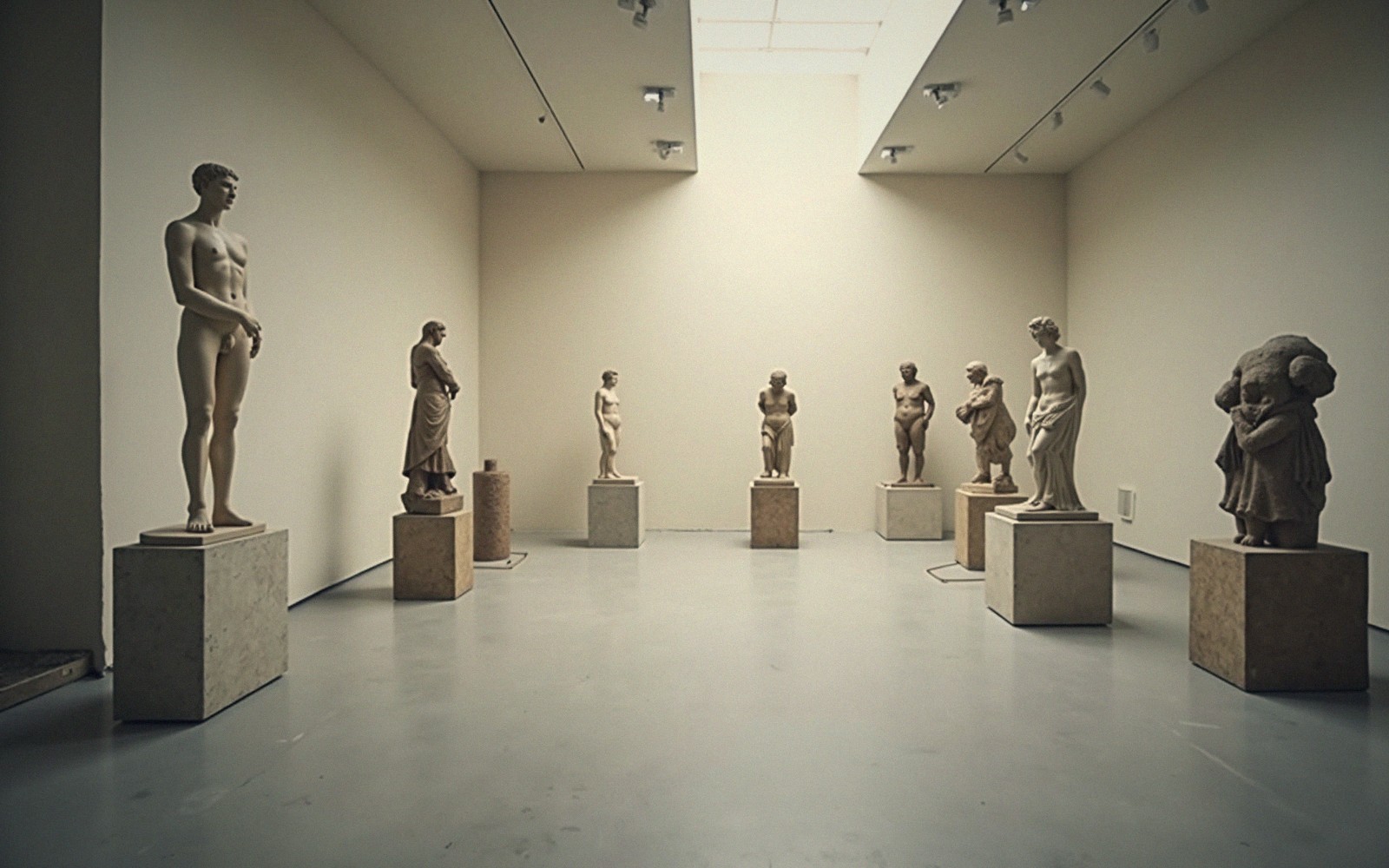
The great ateliers remain the heart of the visit. Plaster casts in various states of finish crowd the shelves and floor — the working detritus of a sculptor's practice, left more or less as it was. There is something almost confrontational about the plasters: raw, white, studiously undecorative, they make the finished bronzes elsewhere feel almost glossy by comparison. Together they give the museum its distinctive texture. You are not looking at a curated selection of masterpieces on white walls; you are standing inside a working life.
Among the collection's highlights are the preparatory works and final pieces related to the Monument à Beethoven and the large decorative friezes Bourdelle made for the Théâtre des Champs-Élysées — commissions that placed him at the centre of Parisian cultural life in the early twentieth century. These are well contextualised in the galleries, and the scale of the ambition they represent becomes clearer once you have walked through the modest, low-ceilinged ateliers where they began.
- 1885Bourdelle settles at impasse du Maine, Montparnasse
- Early 1900sworks as Rodin's chief studio assistant
- 1910scommissions for the Théâtre des Champs-Élysées friezes
- 1929Bourdelle dies; studio site eventually becomes a museum
Section 04Visiting and Approach
The museum sits on the rue Antoine-Bourdelle, a quiet street that runs off the rue de Vaugirard not far from the base of the Tour Montparnasse. The neighbourhood here is between the grand boulevard to the north and the quieter residential streets to the south — neither tourist Montparnasse nor obscure backwater, but pleasantly in-between. The entrance is easy to miss; it does not announce itself. Once inside the courtyard, the city recedes.
Admission to the permanent collection is free, as with most of Paris's municipal museums, which makes this one of the more accessible deep-dives the Left Bank offers. Temporary exhibitions carry a separate admission and are programmed year-round; they tend to be modest in scale but well-curated, often focusing on Bourdelle's correspondence, process or contemporaries.
The visit pairs naturally with the Zadkine studio-museum on the rue d'Assas — another sculptor's house preserved with its accumulated atmosphere intact, also free, also easy to underestimate from the outside. Together they make a concentrated afternoon in the world of early-twentieth-century studio practice, a period when Montparnasse was producing more serious sculpture per square metre than anywhere else in Europe. Bourdelle knew Ossip Zadkine's generation, and Constantin Brâncuși's studio (now reconstructed beside the Centre Pompidou) completes the triangle if you have the day for it.
Allow ninety minutes at Bourdelle — less if you're selective, more if you find the plasters hold you, as they often do. The garden, if the weather permits, deserves time alone. There is a bench along the far wall where you can sit with the bronze Bourdelle straight ahead and the sounds of the street absolutely elsewhere. It is one of those incidental, unscheduled Left Bank moments that no itinerary quite prepares you for.
Who & wherePeople & Places
Antoine Bourdelle (1861–1929)
French sculptor, Rodin's assistant, worked in Montparnasse for four decades
Auguste Rodin
sculptor; Bourdelle's teacher and employer
Ossip Zadkine
cubist sculptor whose nearby studio is now also a Paris municipal museum
Constantin Brâncuși
Romanian-French sculptor, contemporary; his studio reconstructed at Centre Pompidou
Théâtre des Champs-Élysées
major Paris concert hall; Bourdelle created its decorative friezes
rue Antoine-Bourdelle
quiet 15th-arr. street where the museum entrance is located