Section 01
Two hundred metres above the boulevard, at the hour when Paris turns itself into light — how to do the Tour Montparnasse properly.
Section 02Go Up at the Right Moment
There are two versions of the Tour Montparnasse: the one the city looks at, and the one you look from. Parisians have never quite forgiven the tower its presence on the skyline — the outcry after its 1973 completion was fierce enough to trigger regulations banning comparable towers from the city centre for decades — but from the top, the same building delivers something the Eiffel Tower cannot. Up there, the Eiffel Tower is part of the view.
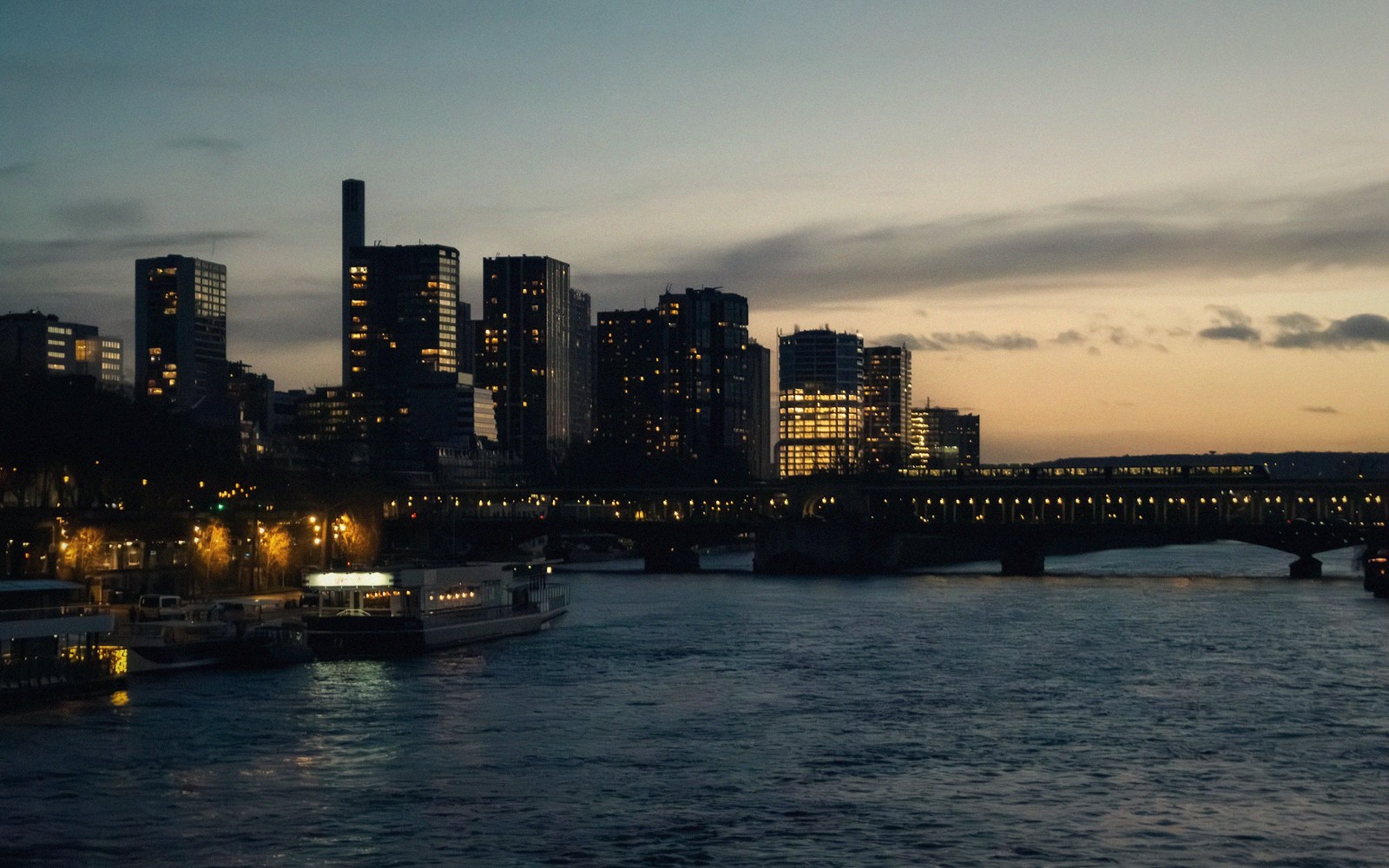
The tower stands 210 metres, the tallest skyscraper in Paris proper, and on a clear evening the panorama reaches some forty kilometres in every direction. But the building is only as good as your timing. Come at noon on a bright summer Saturday and you'll queue, squint and leave with nothing more than a certificate that you were there. Come at blue hour — that twenty-minute interval between the last fire of sunset and the first hard dark of night — and the city does something genuinely extraordinary. The Seine goes silver. The dome of the Panthéon, the long spine of Haussmann's boulevards, the cream and grey geometry of the arrondissements spreading north toward Sacré-Cœur: all of it resolves in extraordinary clarity before the sodium lights blur it back into amber.
The lift from the lobby to the 56th floor is famously fast — under a minute, one of the quickest high-rise ascents in Europe. The enclosed observation level at 56 takes up the whole floor; café, bar, telescopes, the glass panels that frame the city in sections. On a mild evening, push on up to the open terrace at the very top. The wind there can be brisk even in summer, and in winter it is not a place to linger underdressed, but the unobstructed air and the absence of glass between you and the city justify the extra flight.
There are two versions of the Tour Montparnasse: the one the city looks at, and the one you look from.
Section 03Reading the View
Paris, seen from above at dusk, is a lesson in its own logic. The Rive Gauche spreads immediately beneath you — and the quarter you've been walking all evening suddenly makes sense as a shape. The long straight run of the boulevard du Montparnasse heads east-northeast through Carrefour Vavin before the streets tighten into the Latin Quarter and the river stops everything. The Jardin du Luxembourg is visible as a precise rectangle of dark green, its formal geometry clear from altitude in a way it never is at ground level.
Scan west along the Left Bank and you pick up the gilded dome of Les Invalides, the École Militaire beyond it. Due north, across the river, the Louvre is vast, almost startling in scale — it looks from up here less like a museum than a small city embedded in the fabric of a larger one. The Eiffel Tower, lit in its nightly gold, anchors the western middle distance, and the Grande Arche at La Défense sits on the horizon in perfect axial alignment with the Arc de Triomphe and the Louvre's Cour Napoléon, the whole eight-kilometre axis of Parisian grandeur compressed into a single sightline.
At ground level, Saint-Germain-des-Prés always seems like a world apart from Montparnasse — different tribe, different century, different café culture. From up here, you see it differently: it's three minutes of dense rooftop between your boulevard and the river, the church tower of Saint-Germain-des-Prés rising modest and dark above its neighbourhood. The separation between the great Left Bank quartiers, so vivid at street level, dissolves at altitude into one great continuous city.
Section 04A Practical Word
The tower is open into the evening, with extended hours on summer nights — precise times are posted on the official site and subject to seasonal adjustment, so check before you go. The crowd thins noticeably after dinner; if you eat on the boulevard first, the queues on the 56th floor tend to ease, and you arrive in a better mood for the view.
The enclosed floor has a proper bar. A glass of wine at 210 metres as the city lights themselves up is an extravagance that costs relatively little and delivers more than it has any right to. There is no dress code, no tasting menu required. It is, at its simplest, a room with an extraordinary window.
One more thing: orient yourself before you go up. Walk the quarter for an hour — down the boulevard du Montparnasse, around the side streets near Carrefour Vavin, through the back routes below the cemetery — so that when you are looking down from the 56th floor, the map you've made with your own feet assembles itself beneath you. That is the real trick of the tower. It turns a walk you've already taken into something you can see whole, and the city, which seemed inexhaustible at street level, shows you its shape at last.
Who & wherePeople & Places
Tour Montparnasse
210-metre office and observation tower on the boulevard du Montparnasse
Carrefour Vavin
key crossroads at the heart of the Montparnasse quarter
Jardin du Luxembourg
formal public garden at the northern edge of the quarter
Eiffel Tower
western mid-distance landmark visible from the top terrace
Grande Arche, La Défense
horizon landmark on the historical east–west axis