Section 01Tower to Terrace: The Night Crawl from Montparnasse to Saint-Germain
From the summit of the Tour Montparnasse to a last glass in Saint-Germain-des-Prés — one walkable evening, stop by stop.
Section 02Start High, Then Walk Down Into the Night
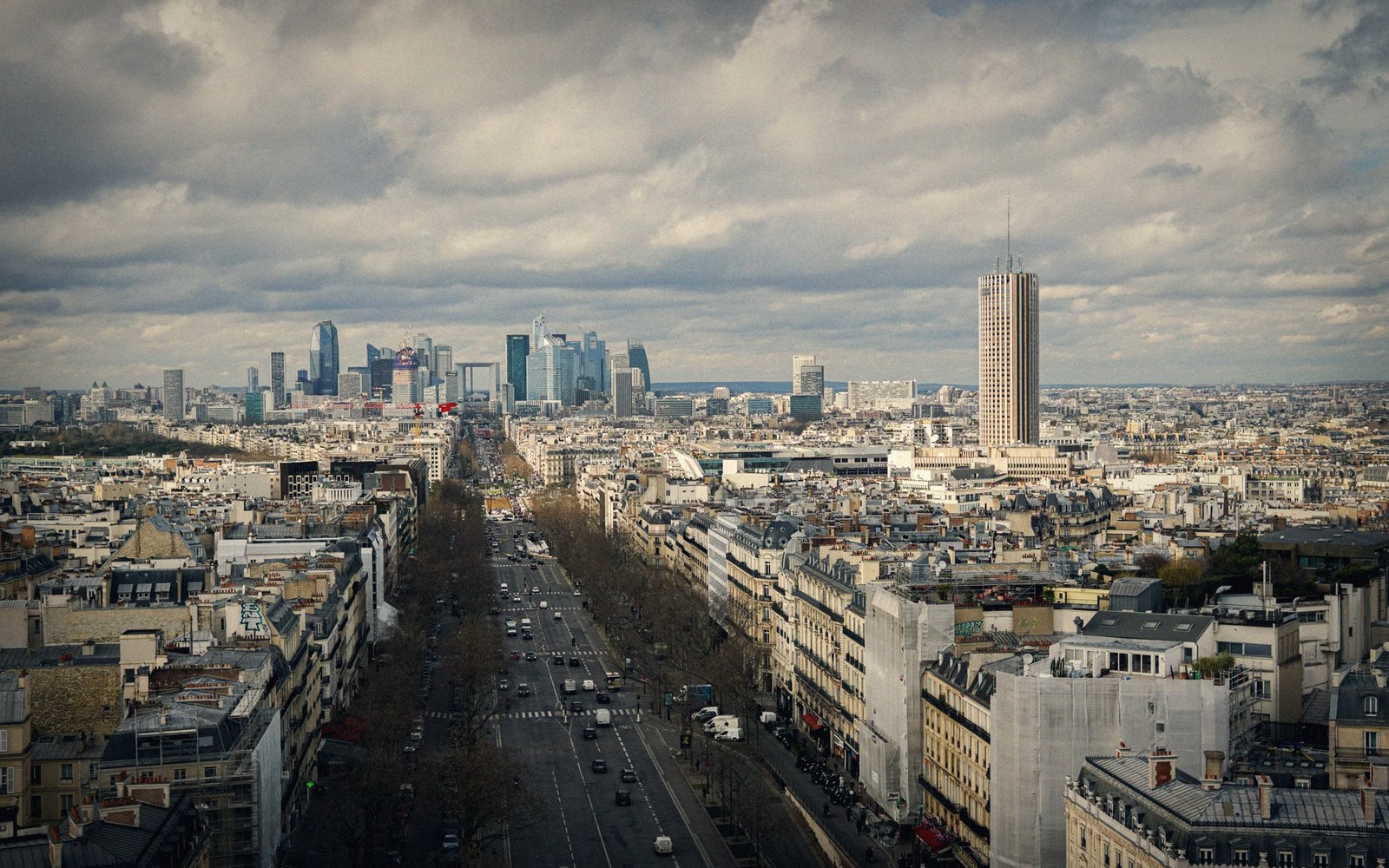
Begin at the top. The Tour Montparnasse rises 210 metres above the 15th arrondissement, and on a clear evening the lift delivers you to a view that reframes everything: the Seine a dark ribbon, the Île de la Cité lit like a jewel box, and the whole Left Bank spread below you in amber and shadow. From up here, the walk ahead looks small — a few bright arteries, a handful of lit squares. That's the right way to start: with a sense of proportion, and the night still intact.
Ride back down and you're on the place du 18-Juin-1940, named for de Gaulle's BBC broadcast rather than any street geometry. It's a broad, functional square, but turn your back on the station and face north: the boulevard du Montparnasse opens ahead of you, and this is where the evening properly begins.
From up here, the walk ahead looks small — a few bright arteries, a handful of lit squares.
Section 03The Boulevard: Cafés, History, Forward Motion
Walk northeast along the boulevard. Within a few minutes you reach Carrefour Vavin, the intersection that was, for roughly two decades in the early twentieth century, one of the most electrically alive crossroads in the world. La Rotonde, Le Dôme, and La Coupole are all within a short walk of each other here — the grand brasseries where Hemingway nursed cheap wine, Modigliani startled the terraces, and Simone de Beauvoir and Jean-Paul Sartre held court as if the café were an annex of the university. On a warm night, every terrace hums; the awnings are still striped, the zinc bars still cold to the touch. Step inside La Coupole long enough to look at the painted pillars — each one was decorated by a different artist in 1927, and the room retains a faded grandeur that rewards a slow circuit, a drink in hand.
Back outside, cross to the quieter side streets. Rue de la Grande-Chaumière runs south off the boulevard, narrow and slightly worn, lined with old art academies. Modigliani worked here; so did a generation of painters who had come from elsewhere — Poland, Romania, Russia — and made this quarter the capital of what became known as the École de Paris. The street is quiet now, but it carries its past without making a fuss about it.
Cut south to the rue Antoine-Bourdelle and you'll pass the entrance to the Musée Bourdelle, closed at night but just visible through the gate: the courtyard where enlarged bronze heads loom in the darkness, Rodin's most gifted student still commanding the space he worked in for fifty years. It's worth pausing.
- early 20th centuryCarrefour Vavin era, peak of Montparnasse artistic life
- 1927La Coupole opens
- postwarSaint-Germain-des-Prés becomes centre of existentialist intellectual life
Section 04Through the Garden, Into Saint-Germain
Now turn north and let the streets carry you toward the Jardin du Luxembourg. The garden closes at dusk, so you'll navigate its boundary rather than its paths, but even the high railings and the dark crowns of the chestnut trees have a particular quality at this hour — a sense of the city breathing slowly behind its walls. The Musée du Luxembourg sits at the garden's northern edge, and if the evening is mild, the rue de Vaugirard that borders it is one of the most agreeable streets in Paris for doing nothing in particular.
From here, Saint-Germain-des-Prés is ten minutes on foot heading northeast. The neighbourhood shifts as you cross into it: the streets narrow fractionally, the ground floors grow more expensive, and the church tower of Saint-Germain appears ahead — one of the oldest in Paris, its stones blackened and stoic. The quarter was famously the address of postwar existentialism; de Beauvoir wrote in the Café de Flore, Sartre rewrote himself at Les Deux Magots, and the cellars below the surrounding streets once shook with jazz. That jazz culture has its own continuation further underground still — the live jazz scene of the Left Bank runs deeper than any single address.
The walk ends where you feel inclined to end it. A glass of something on a terrace along the boulevard Saint-Germain, watching the last taxis move; or a quieter room, off the main drag, where the piano continues past midnight. The route itself is the point — roughly two kilometres of the Left Bank at its most characteristic, moving from the blunt modernity of the tower through the artistic history of the boulevard into the philosophical myth of Saint-Germain. It all fits in an evening, and it all coheres in a way that, honestly, you only feel on foot, and only after dark.
Leave enough time for the last Métro. Or don't.
Who & wherePeople & Places
Carrefour Vavin
the intersection at the heart of Montparnasse café culture
La Coupole
grand Art Deco brasserie, opened 1927, pillars painted by different artists
École de Paris
loose grouping of mainly immigrant artists working in Montparnasse
Antoine Bourdelle
French sculptor, pupil of Rodin; studio now a museum on rue Antoine-Bourdelle
Simone de Beauvoir / Jean-Paul Sartre
existentialist philosophers, habitués of Saint-Germain cafés